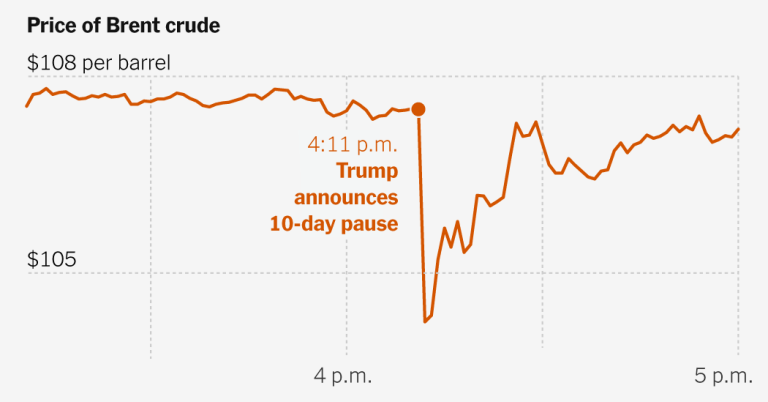
How markets respond to President Trump’s proclamations about the war with Iran can have big effects on prices. Sometimes the price of oil has swung instantaneously in reaction to his words, and other times the market has shrugged.
The market now seems more skeptical when Mr. Trump says the conflict may end soon — which means he may find it harder to knock prices downward simply by making such announcements. His pronouncements also come as fighting continues across the Gulf, including strikes on energy infrastructure. A blockade on tankers delivering oil from the region is also factoring into traders’ actions.
To see this shifting sentiment, let’s rewind two weeks to Monday, March 23, when Mr. Trump announced on Truth Social a five-day pause in energy infrastructure strikes and the start of negotiations with Iran (which Iran denied took place). Here is what happened to the price of Brent crude, the global benchmark for oil:
Traders reacted quickly, sending the price of oil futures sharply down. Mr. Trump’s announcement seemed to reassure traders that the Strait of Hormuz, already choked off to oil tankers, would not get worse. Oil prices generally fall when pressures on the supply of oil ease.
Iran’s main form of leverage is oil prices, said Adam Kobeissi, editor in chief of the Kobeissi Letter, a financial newsletter: “As long as prices continue to push higher, President Trump will continue to hedge this military campaign by putting out these headlines to try and contain the market.”
Since then, however, oil futures haven’t responded to the same degree to similar statements by the president.
On March 26, Mr. Trump announced a 10-day pause in strikes. This time, oil futures dipped again briefly, but not by nearly as much as they had when Mr. Trump announced the five-day pause. And they bounced back close to their previous price within minutes.
By the following Monday, March 30, oil futures had returned to roughly the price they had been before Mr. Trump talked about diplomacy the previous week. And the market was now seeming to ignore Mr. Trump’s pronouncements, in which he often seesawed between diplomacy and threats.
That morning, Mr. Trump announced that the United States was in “serious discussions” with Iran about ending the American military campaign, while also threatening to obliterate Iran’s energy infrastructure if a deal was not reached and the Strait of Hormuz was not reopened. The market stayed flat.
Oil futures by this point might have already priced in the signal that the war would not escalate further. But trade through Hormuz was still essentially blocked, with little sign of improvement, no matter the president’s suggestion that the war might soon end.
On Wednesday morning, Mr. Trump posted on Truth Social that Iran had asked for a cease-fire, though Iran’s top diplomat earlier denied that negotiations were underway.
In the same post, Mr. Trump also wrote, “Until then, we are blasting Iran into oblivion.” Again, oil prices remained flat.
But that evening, in his televised address to the nation, Mr. Trump vowed to continue bombing Iran — while offering no new information about when he expected the war to end. That caught the market’s attention: As Mr. Trump delivered his remarks, the price of oil climbed.
After these ups and downs, the price of oil is once again about where it was before Mr. Trump announced the negotiations and the pause in strikes two weeks ago. It closed at $109 per barrel on Thursday, up more than 50 percent since the war’s start.
For U.S. gas prices, that has translated to a jump to $4.10 a gallon on Saturday, from $2.98 a gallon before the war, per the AAA national average.
Francesca Paris contributed work on graphics.