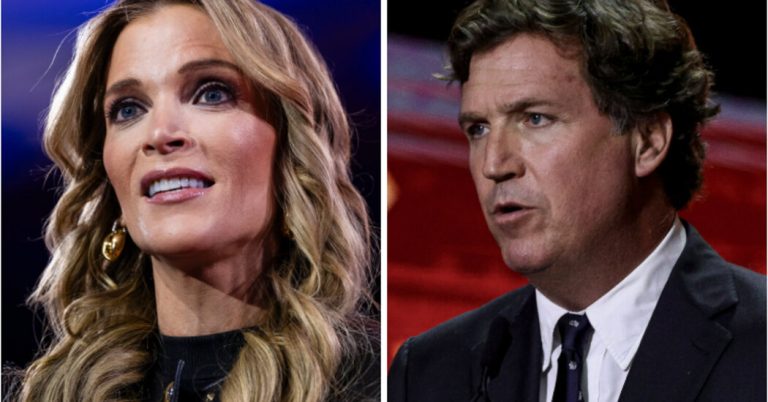
The podcaster Megyn Kelly and the Fox News host Mark Levin are two of the country’s best-known conservative influencers. She opposes the war in Iran. He supports it.
Ms. Kelly, herself a former Fox News host, recently argued that the war was sold to the American people by “Israel firsters like Mark Levin.” He called her an “emotionally unhinged, lewd and petulant wreck.” It only got uglier from there.
As the joint U.S.-Israeli military action against Iran rolls into its third week, leading figures of the MAGA movement have attacked each other with increasing vehemence over the wisdom of the war, and more broadly, what the American relationship to the Jewish state should be.
The debate reflects a widening rift within the American conservative movement. For decades, conservatives were stalwart supporters of the Jewish state, but over the last few years, some have grown disenchanted with Israel and its role in American politics. The disagreements have only intensified since the attacks began on Feb. 28.
Mr. Trump, a president uniquely solicitous of, and sensitive to, the right-wing media sphere, weighed in over the weekend on the dispute between Ms. Kelly and Mr. Levin, taking the latter’s side.
“Those that speak ill of Mark will quickly fall by the wayside,” Mr. Trump wrote on his social media platform Truth Social. Despite repeatedly pledging on the campaign trail to avoid foreign conflicts, he defended the current war as consistent with the precepts of his movement “THEY ARE NOT MAGA, I AM,” he stated.
Joining Mr. Trump’s side of the debate are politicians like Senators Ted Cruz and Lindsey Graham, and media figures like Ben Shapiro, a prominent podcaster who has called those who oppose the attacks on Iran “cowards, liars and America haters.” Mr. Shapiro, who, like Mr. Levin, is Jewish, also singled out Ms. Kelly as an “unbelievable coward” for believing, as she said, that “no one should have to die for a foreign country.”
The critics have been equally withering. Tucker Carlson, the well-known podcaster, has been selling ball caps, T-shirts and coffee mugs emblazoned with messages like, “Neocons are Gay For Israel” and “AIPAC An Offer You Can’t Refuse,” crude and unsubtle attacks on the American Israel Public Affairs Committee, the pro-Israel lobbying group, and other defenders of Israel.
Mr. Carlson has called the strikes “absolutely disgusting and evil” and said they occurred because “Israel wanted it to happen.”
Similar anti-Israel sentiments have been expressed by other far-right figures, including the podcaster Alex Jones and former Representative Marjorie Taylor Greene, as well as by more moderate voices like the podcaster Joe Rogan and the influential conservative intellectual and Trump critic Andrew Sullivan.
Mr. Sullivan wrote last week that he believed the attack was essentially an Israel first, rather than an America first, proposition.
“In plain English,” Mr. Sullivan stated, “this is what is in front of our nose: a corrupt, deranged monarch pursuing an illegal and immoral war primarily to benefit a foreign country.”
White House officials contend that Mr. Trump’s base is with him on this war, citing recent polls showing that majorities of self-identified “MAGA Republicans” support it.
“Claims that the noble Operation Epic Fury will somehow fracture the president’s base are not backed by or reflected in the data,” said Olivia Wales, a White House spokeswoman, in an email.
But the heated disagreement over attacking Iran, which shows no sign of abating, sets this conflict apart from previous military actions in Kuwait, Afghanistan and Iraq, which began with more unified support from conservatives.
The division has colored conversations about recent attacks, threats and vandalism within the United States since the war began. After a Lebanese immigrant attacked a Michigan synagogue last week, Laura Loomer, the pro-Israel right-wing influencer, posted that “Tucker Carlson, Nick Fuentes and Candace Owens all have blood on their hands,” referring to Mr. Carlson and two antisemitic right-wing celebrities. “This is what they have been pushing for with their rhetoric and attacks on Jews.”
The internecine brawling could also inject an element of drama to the upcoming Conservative Political Action Conference this month in Dallas. Planned speakers at the event include Reza Pahlavi, the son of the former shah of Iran, who supports the military action, and Stephen K. Bannon, the former Trump campaign manager and podcaster, who recently accused Israel’s prime minister, Benjamin Netanyahu, of tricking Mr. Trump into a “regime change” war.
It remains to be seen whether the war will have a lasting impact on American attitudes toward Israel. Polling shows that sizable support for Israel still exists, but that it is eroding, especially among Republicans younger than 50. A March 2025 poll by Pew Research found that 50 percent of these younger Republicans had a negative view of Israel, compared to 35 percent in 2022. Republicans 50 and older also had a more negative view of Israel, rising to 23 percent last year from 19 percent in 2022.
Overall, the 2025 poll found that 53 percent of Americans held a negative opinion of Israel, an increase of 11 percentage points compared to three years earlier.
“In general, there’s been a transformation, and that transformation has, you know, just shifted the way people see Israel and its role,” said Shibley Telhami, a politics professor at the University of Maryland who tracks American attitudes about Israel.
Older Americans, versed in the horrors of the Holocaust, grew up seeing Israel as the lone democratic outpost in a complex, strife-ridden part of the world and an essential homeland for an oppressed people. Few in Gen Z, by contrast, have ever met a Holocaust survivor. Their views are instead informed by having come of age during the Iraq and Afghanistan wars, and they tend to view Palestinians, rather than Jews, as the oppressed people, especially after the conflict in Gaza erupted in October 2023.
“Young people don’t get it — they don’t understand why we are so close to Israel,” said Curt Mills, editor of the American Conservative, which was founded by an ardent anti-interventionist, Pat Buchanan, who was frequently accused of being antisemitic.
Critics of the war have seized on the March 2 comments by Secretary of State Marco Rubio, who told reporters that the United States had initiated its attacks only after learning that Israel had already planned to strike. “We knew that would precipitate an attack on U.S. forces,” Mr. Rubio said. “If we didn’t pre-emptively strike before they launched those attacks, we would suffer more casualties.”
Although he tried to walk back the comments, critics widely interpreted them as an admission that the United States was acting at Israel’s behest rather than in pursuit of its own national interests.
“Rubio’s statement did nothing to disabuse the crazier conspiracy theorists from going down that rabbit hole,” said David Myers, a professor of Jewish history at the University of California, Los Angeles. “It’s potentially really combustible.”
For now, it is difficult to know how the hostilities within the conservative movement, much like the war itself, will end, and what that end might look like. For conservatives like Laurie Cardoza Moore, an Israel supporter and critic of Mr. Carlson, the question could not be more serious.
“This is going to be the defining moment of the Republican Party, of the conservative movement,” she said.