If Democratic voters wanted party leaders to give a strong, unanimous condemnation of President Donald Trump’s war on Iran, they would probably be disappointed. Leaders of the liberal party have instead sought to criticize the process leading up to Trump’s multiday onslaught, rather than the onslaught itself.
Soon enough, however, primary elections will give voters their say on that approach.
Starting Tuesday, a series of primaries will serve as referenda on candidates who have either given ambivalent responses to the war or who have drawn past support from the American Israel Public Affairs Committee, the pro-Israel lobbying flagship that backed Trump’s strikes.
The first big test will come in North Carolina, where Democratic Congressional Campaign Committee-backed incumbent Rep. Valerie Foushee is under attack from challenger Nida Allam over prior ties to AIPAC.
Allam, a Durham County commissioner hoping to topple Foushee in the 4th Congressional District, chose to make the U.S. strikes on Iran the subject of her final pitch to voters in a video ad where she condemned the war.
“I have opposed these forever wars my entire career.”
“I will never take a dime from defense contractors or the pro-Israel lobby,” Allam said. “I have opposed these forever wars my entire career, and I hope to earn your vote to be your proudly uncompromised pro-peace leader in Washington.”
Taking heat from Allam, Foushee says she also opposes the war.
“I will go on record right now: I do not support Trump’s illegal war with Iran and will do everything I can in Congress to support War Powers Resolutions to stop it,” Foushee said on social media Saturday morning, hours after the bombs began dropping.
A super PAC affiliated with AIPAC gave Foushee crucial support during her 2022 race. With the lobbying group’s brand becoming increasingly toxic within the Democratic Party, she has sworn off support from the organization this time around — but a group tied to an AIPAC donor has nonetheless flooded the race with ads on her behalf.
The North Carolina candidates’ stances reflect the overwhelming sentiment of Democratic voters, according to a pair of polls conducted over the weekend. Only 27 percent of Americans and 7 percent of Democrats approve of the attacks, according to a Reuters/Ipsos poll that lined up with the results of a Washington Post survey.
Avoiding the Underlying Issue
Democratic leaders in Congress have taken a different tack. Before the strikes, they dragged their feet on forcing a vote on a war powers resolution meant to block launching strikes without congressional approval.
After the attack, many top Democrats criticized Trump’s decision to launch the war without congressional approval, while being vague on the substantive question of whether it was right to go to war.
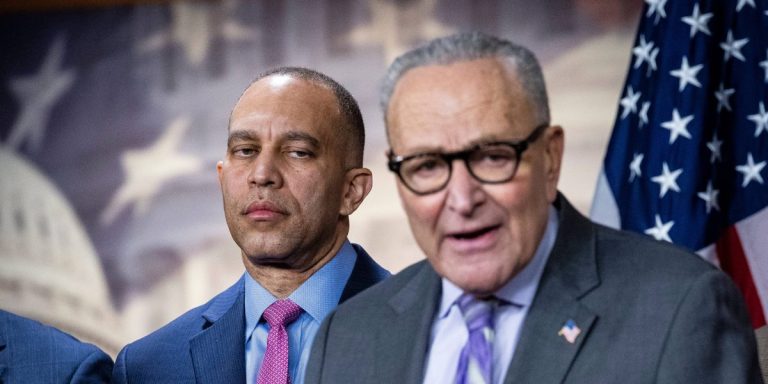
House Minority Leader Hakeem Jeffries, D-N.Y., for instance, tied the attacks to the Democratic campaign theme of affordability and blasted Trump for failing to ask Congress for approval.
Senate Minority Leader Chuck Schumer, D-N.Y., has also stopped short of directly criticizing the idea of attacking Iran. In his statement, he invoked the threat of Iran attaining nuclear weapons, cited the public’s fear of “another endless and costly war,” and called on Congress to pass a war powers resolution.
Those positions allow Democratic leaders to focus their criticism on Trump’s violation of the U.S. Constitution, which grants Congress the sole power to declare war, rather than the underlying issue of whether the war is warranted.
Democrats should be doing more than merely criticizing the process leading up to the war, said Hannah Morris, the vice president of government affairs for J Street, a liberal pro-Israel group that is lobbying members of Congress to support a war powers resolution that blocks Trump from launching further attacks without congressional approval.
“This is not just about process, this is about a reckless war by choice.”
“Process plus. This is not just about process, this is about a reckless war by choice, and it completely flies in the face of what President Trump ran on,” Morris told the Intercept.
One congressional candidate was blunt in her critique of the response from Democratic leaders.
“As we plunge headlong into another catastrophic war, Sen. Schumer and Rep. Jeffries’ throat clearing and process critique only serves Trump and the war machine. Democrats should speak clearly and with one voice: no war,” said Claire Valdez, a state assembly member who is running in New York’s 7th Congressional District with the blessing of New York City Mayor Zohran Mamdani.
Only a few Democratic members of Congress have given their outright support to the war — most notably Sen. John Fetterman, D-Pa.
Even in congressional races where none of the candidates have given the war their blessing, however, there have important distinctions in whether they focus Trump’s wrecking ball approach to the Constitution or the wisdom of the war itself.
In Illinois, a Democratic primary election in the 9th Congressional District on March 17 will give voters a test on whether they want candidates more forthrightly opposed to the conflict.
State Sen. Laura Fine, a top candidate in that race who has drawn the backing of AIPAC donors, supported Israel’s attacks on Iranian nuclear facilities last year. She was one of the candidates centering Trump in her response to the attack over the weekend.
“Donald Trump is leading us into another military conflict to distract from his own failures that puts American lives at risk and threatens to send the Middle East into further chaos,” she said. “He simply cannot be trusted and must be impeached.”
Two candidates vying for the progressive vote, Daniel Biss and Kat Abughazaleh, have both come out against the war. Biss called it “reckless and illegal.” Abughazaleh, a social media influencer, also called out Democrats who were willing to go along with the attacks in a video post.
“The problem is that many lawmakers on both sides of the aisle love playing into the idea of Iran as a boogeyman, and so they’re willing to bomb them to hell. Especially if it lines their pockets or gets them more donors from the military–industrial complex,” she said.
In Maine, firebrand oyster fisher Graham Platner was far ahead of popular two-term Gov. Janet Mills in a recent primary poll.
Platner, a Marine combat veteran, called an emergency protest over the weekend and called the war “tragic, stupid, ill-conceived.”
In her statement, Mills criticized Trump’s “unilateral” decision to go to war while adding that Iran could not be allowed to develop a nuclear weapon.
“The American people have had enough of forever wars,” Mills said, “that put the lives of American servicemembers and civilians in danger, that do not protect the American people, that hurt our alliances and escalate global tensions.”