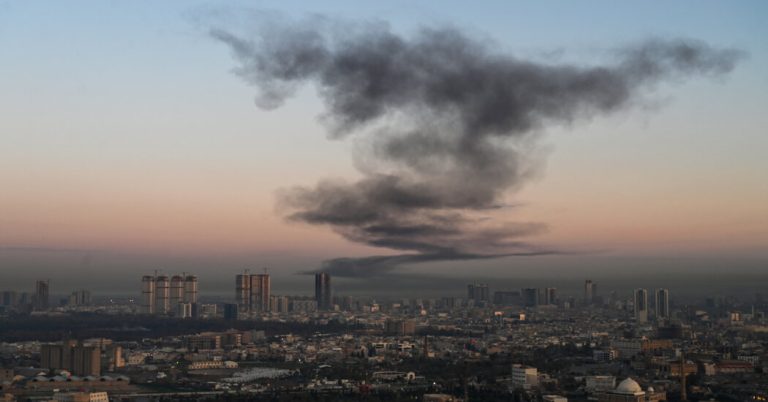
Iran struck a base housing American troops in Kuwait, killing three U.S. service members, military officials said on Sunday, as the stakes for the United States became immediately clear in its latest war in the Middle East.
The fatalities were the first for the United States since the U.S. and Israeli militaries jointly began attacks in Iran on Saturday. The U.S. military’s Central Command said that five service members were “seriously wounded” and several others “sustained minor shrapnel injuries and concussions” in the attack.
The Iranian strikes in Kuwait, at Camp Arifjan, destroyed major portions of an army unit that manages housing for troops in the country, military officials said.
Iranian retaliatory strikes also killed at least nine people in Israel, and four people in other countries in the region. In Iran, the U.S.-Israeli strikes have killed at least 133 civilians and wounded 200 others, according to HRANA, the media agency of an Iranian rights group based in Washington.
For the United States, the grim American toll in the first two days of the war signaled that Iran was more prepared for war than the Trump administration anticipated, U.S. military officials said. Iran has put up a fight, even after its supreme leader, Ayatollah Ali Khamenei, and other top officials were killed in Israeli attacks with intelligence help from the C.I.A.
In the weeks before the war, the United States had assembled its largest military buildup since the Iraq War began in 2003. Since early Saturday, U.S. attack planes launched from bases around the Middle East and from at least one aircraft carrier have carried out hundreds of strikes in Iran.
The supreme leader “was unable to avoid our Intelligence and Highly Sophisticated Tracking Systems and, working closely with Israel, there was not a thing he, or the other leaders that have been killed along with him, could do,” Mr. Trump boasted on social media on Saturday.
The Israeli military said on Sunday its airstrikes had destroyed about 200 ballistic missile launchers and rendered dozens more inoperable over the past two days, taking out roughly half of Iran’s launcher arsenal.
The strikes have also targeted Iran’s central explosives manufacturing facility, which supplies materials for missile warheads and other weapons programs, including rockets, U.A.V.s, and cruise missiles.
On Sunday, the United States continued a wave of strikes, particularly targeting Iran’s ballistic missile program and the Iranian Navy, a Central Command official said.
Air Force B-2 stealth bombers, armed with 2,000-pound bombs, struck Iran’s “hardened” ballistic missile facilities, Central Command said in a statement on Sunday. “No nation should ever doubt America’s resolve.”
Central Command said that so far U.S. strikes have hit the Joint Headquarters of Iran’s Islamic Revolutionary Guard Corps, its Aerospace Forces Headquarters, Iranian air defense systems, ballistic missile sites, submarines and anti-ship missile sites.
In another statement, Central Command said that U.S. forces struck an Iranian warship during the start of the joint American and Israeli attacks on Iran on Saturday. “The ship is currently sinking to the bottom of the Gulf of Oman,” Central Command said on social media. “As the President said, members of Iran’s armed forces, IRGC and police ‘must lay down your weapons.’ Abandon ship.”
But Iran’s armed forces showed no immediate signs of giving up. Since the U.S. and Israeli military strikes began, Iran has launched hundreds of retaliatory missiles at a wide range of American and Israeli targets in the region. It has also launched strikes at Arab countries it considers allies of the United States, including Qatar, the United Arab Emirates, Jordan, Bahrain, Oman and Kuwait.
In the past, Iran has given warning before launching retaliatory strikes and made known which bases housing U.S. troops it intended to hit. This time, the strikes have been widespread. More than 549 drones, 165 ballistic missiles and two Iranian cruise missiles targeted the United Arab Emirates, the Emirati defense ministry said on Sunday. Most were intercepted but 21 drones struck civilian targets, the ministry said.
U.S. military officials warned on Sunday that the military has been burning through Tomahawk missiles and other munitions.
Gen. Kenneth F. McKenzie Jr., a former leader of Central Command, said it would probably become clear in the next 48 to 72 hours whether Iran could maintain its heavy barrage of retaliatory missile strikes as the U.S. and Israeli militaries targeted Iran’s arsenal.
“It’s a race,” General McKenzie said in an interview.
Not all U.S. missile strikes may have hit their intended military targets.
The Pentagon said on Saturday it was investigating reports of Iranian civilian deaths caused by military strikes inside the country. More than 100 people, probably most of them children, were killed in a strike that hit a girls’ elementary school in southern Iran, according to Iranian health officials and state media.
“We are aware of reports concerning civilian harm resulting from ongoing military operations,” said Capt. Tim Hawkins, a spokesman for Central Command. “We take these reports seriously and are looking into them. The protection of civilians is of utmost importance, and we will continue to take all precautions available to minimize the risk of unintended harm. Unlike Iran, we have never — and will never — target civilians.”
Mr. Trump said in a Truth Social post on Saturday that “heavy and pinpoint bombing” would continue “uninterrupted throughout the week or, as long as necessary to achieve our objective of PEACE THROUGHOUT THE MIDDLE EAST AND, INDEED, THE WORLD!”
A U.S. military official confirmed that U.S. strikes would “continue” but did not say for how long.
Daniel Byman, a professor at Georgetown University’s School of Foreign Service, said the United States would find it difficult to sustain large-scale operations at a rapid pace.
Despite the size of the U.S. buildup, it is still small compared with the forces assembled for the 2003 invasion of Iraq and appeared more appropriate for a multiday bombing campaign than a long war, he said.
“The rapid pace of operations requires large numbers of missiles and air assets,” said Mr. Byman, who is also the director of the warfare, irregular threats, and terrorism program at the Center for Strategic and International Studies. “Although the United States has deployed a large force to the region, this rapid pace will place a strain on the platforms and the operators.”
And it is not at all clear who will control Iran in the coming days.
“The regime still might be able to stay in power, even if the United States and Israel inflict significant damage on the regime’s leadership and military forces,” Mr. Byman said.
John Ismay contributed reporting.