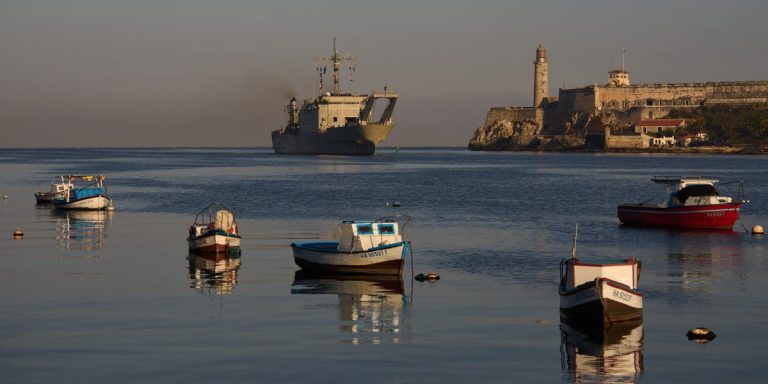
The Cuban government said it returned fire following an attack by passengers on a Florida-based speedboat that had entered its territorial waters on Wednesday. Cuba’s Ministry of the Interior said its border guards killed at least four people aboard the U.S. boat and wounded six others.
A U.S. government official said the firefight did not involve U.S. Navy or Coast Guard vessels but a civilian boat. The speedboat approached within one nautical mile northeast of the El Pino channel north of Corralillo, a town in the central Cuban province of Villa Clara, according to an official statement by the Cuban government.
Cuban border guards on a government vessel approached the speedboat seeking identification when people aboard the American boat opened fire on the Cuban personnel, wounding the Cuban vessel’s commander, the statement said.
“As a result of the confrontation, at the time of this report, four foreign attackers were killed and six were wounded,” according to the Cuban government.
The firefight comes during a pressure campaign by the Trump administration that is causing immense hardship on the island. In the past, the U.S. military drew up secret plans for a false-flag attack in Cuban waters to justify a U.S. military intervention.
The U.S. military has been regularly carrying out attacks on supposed drug boats in the Caribbean, the most recent on Monday, killing three people. There have now been 44 such attacks in the Caribbean and Pacific Ocean, killing at least 151 people since September.
The Cuban government said on Wednesday that the “injured individuals were evacuated and received medical assistance.” The U.S. government, by contrast, has killed survivors clinging to wreckage or left boat strike victims to drown.
The Defense Department and the U.S. Coast Guard referred all questions about Wednesday’s attack to the State Department, which did not reply to multiple requests for comment.
Florida Rep. Carlos Gimenez called for revenge on Wednesday, despite the fact that all reports indicate that the American boat attacked the Cuban vessel. “The dictatorship in #Cuba has just attacked a boat from Florida & murdered those on board,” he wrote on X. “This regime must be relegated to the dust bin of history!”
The Trump administration has been ratcheting up pressure on Cuba’s Communist government and extreme pain on its people, cutting off foreign oil shipments and other revenue sources that had kept Cuba’s rickety economy afloat. The pain has increased after oil shipments from Venezuela, its main supplier, were halted after the U.S. attacked the South American country, kidnapped its then-president Nicolás Maduro, and began running the country via a puppet regime. Mexico, another major petroleum supplier, also suspended oil shipments under U.S. pressure. This has sparked a humanitarian catastrophe of food, medicine, and fuel shortages, raging inflation, prolonged blackouts, and service cuts at hospitals.
“In the face of current challenges, Cuba reaffirms its determination to protect its territorial waters,” the Cuban government said in a statement. “Based on the principle that national defense is a fundamental pillar of the Cuban State in safeguarding its sovereignty and ensuring stability in the region.”
Many U.S. presidents have attempted to overthrow the Cuban government. During the Cold War, the CIA launched the disastrous 1961 Bay of Pigs invasion. The agency also tried to assassinate Cuban leader Fidel Castro at least eight times. The U.S. also conducted a covert campaign of bombing Cuban sugar mills and burning cane fields, among other acts of sabotage.
In the wake of the Bay of Pigs debacle, the Pentagon prepared top-secret plans to excuse an attack on the island. In the spring of 1962, the Joint Chiefs of Staff circulated a top-secret memorandum titled “Justification for U.S. Military Intervention in Cuba.” It described numerous false-flag operations that could be employed to justify a U.S. invasion. These proposals included staging assassinations of Cubans living in the U.S.; developing a fake “Communist Cuban terror campaign in the Miami area … and even in Washington”; a plot to “sink a boatload of Cuban refugees (real or simulated)”; faking a Cuban air attack on a civilian jetliner filled with “college students”; and even staging a modern “Remember the Maine” incident by blowing up a U.S. ship in Cuban waters — and then blaming the incident on Cuban sabotage.