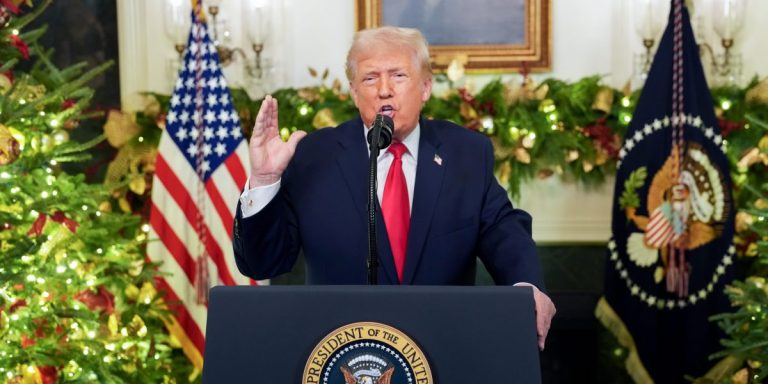
Last night, Donald Trump took the stage and announced in a bizarre, rambling speech what he framed as a gift to America’s troops: a one-time, $1,776 “warrior dividend,” a $1,776 payment pitched as gratitude for service members and veterans. Wrapped in Revolutionary War imagery and just in time for the holidays, the promise was sold as proof that Trump takes care of our warriors. But beneath the applause and bunting, the announcement amounted to another empty, Trump-branded PR exercise.
In reality, what Trump sold as a Christmas “warrior dividend” wasn’t a new benefit at all. As Politico reported, the money came from a military housing stipend Congress had already approved months earlier to address lagging quality-of-life conditions for service members. Under Trump, that benefit was simply rebranded, repackaged, and redelivered — not as a right earned through service, but as a personal gift bestowed from above.
Trump’s sudden burst of generosity comes after years of deliberate harm to veterans, military families, and the institutions meant to support them.
Among veterans, the reaction was sharper — and darker. Former service members joked the dividend felt like a “steak and lobster deployment dinner,” the old military omen: When leadership suddenly splurges, bad news usually follows. Combat veteran and military accountability activist Greg Stoker summed it up more bluntly on Instagram, calling the announcement “corny as hell,” a sentiment echoed across veteran circles who’ve learned to distrust flashy gestures that arrive just before cuts, purges, or new demands.
That context matters. Trump’s sudden burst of generosity comes after years of deliberate harm to veterans, military families, and the institutions meant to support them. Set against that record, the “warrior dividend” isn’t gratitude — it’s the latest insult. For $1,776, a number that barely covers a month’s rent in much of the country, Trump seems to believe he can purchase loyalty, silence dissent, and paper over structural harm.
“Suckers”
This indifference isn’t an abstraction. Last week on Capitol Hill, Homeland Security Secretary Kristi Noem assured lawmakers that Immigration and Customs Enforcement has “not deported” military veterans. As she spoke, an Army veteran appeared on screen from exile. Sae Joon Park, a Purple Heart recipient wounded in combat, had been deported to South Korea after nearly 50 years in the United States, ordered to self-deport over decades-old drug charges tied to his post-traumatic stress disorder. As Noem offered perfunctory thanks for his service and claimed her hands were tied, Rep. Seth Magaziner, D-R.I., cut in: Park had taken two bullets for his country — would the administration help him come home? Noem promised only to “look at his case.” The lie had already been exposed.
Park’s case is not an anomaly. Under Trump, military service has offered little protection from detention or deportation. During his first term, immigration authorities placed at least 250 veterans into removal proceedings and deported 92 of them, many of whom have service-connected trauma from their time in combat. Among them was Miguel Perez Jr., an Army veteran who served two tours in Afghanistan before being deported to Mexico. Just last month, Jose Barco, a Purple Heart recipient wounded in Iraq, was deported from a detention center in Arizona at 4 a.m.
Treating war heroes as disposable reflects how Trump fundamentally understands the military. He does not treat the military as a civic institution bound by mutual obligation or constitutional restraint. He treats it as a coercive instrument — a disciplined force that can be displayed, redirected, or withdrawn depending on political need. Loyalty, in this framework, is not owed to the Constitution but to the ruler. Compliance is rewarded with praise; independence is punished with humiliation or exile. In Trump’s worldview, soldiers are not citizens who serve; they are assets to be deployed, threatened, or discarded. That calculus explains everything from the casual talk of executing generals, to the weaponization of National Guard deployments, to the ease with which veterans are deported or fired, to reportedly calling troops “suckers.”
Beyond the rhetoric, Trump’s policies have inflicted concrete harm on veterans. His administration is gutting the Department of Veterans Affairs, planning to eliminate more than 70,000 jobs and roll staffing back to pre-2019 levels. Hundreds of VA clinicians warned Congress that the cuts threaten veterans’ health care nationwide. Internal data show the VA has already lost more than 600 doctors and nearly 2,000 nurses, while appointment wait times creep upward. One Democratic member of the Senate Veterans Affairs Committee summed it up as “a full-scale, no-holds-barred assault on veterans.” Trump’s answer has been privatization — diverting billions to for-profit providers and pushing veterans toward telehealth stopgaps or long drives to private clinics as the VA’s capacity erodes.
The ideology behind these cuts has been stated plainly. “DEI is dead,” said Trump’s handpicked “Secretary of War” Pete Hegseth — as if staffing, access, and continuity of care were political indulgences rather than lifelines. In practice, that posture means fewer PTSD counselors, fewer clinicians in rural hospitals, and fewer staff processing disability claims and GI Bill benefits. The result is predictable: a growing population of veterans left to navigate trauma and bureaucracy alone, after the country that sent them to war decides it is finished paying its share.
That assault on the VA is part of Trump’s broader purge of the federal workforce — a purge that disproportionately harms veterans. Roughly 1 in 4 federal civilian employees is a veteran, and nearly 900,000 veterans and military spouses work in federal jobs. In less than a year, 100,000 federal workers were pushed out through firings or “buyouts.” Now entire agencies face decimation under Trump’s so-called Schedule F plan, aiming to liquidate government “waste” — and with it, the livelihoods of those veteran employees. Each statistic is a human story: an Air Force veteran and sole breadwinner losing her second career just months in; a disabled Navy veteran in tears after being canned from the Department of Education. “He said he wanted to make the country great again… but this is not making it great, said Cynthia Williams, an Army vet in Michigan who lost her federal job. For veterans who once believed Trump’s promises, these actions feel like a stab in the back. As one discarded veteran bluntly put it: “I feel like I got a big F-you from the American people, and I feel betrayed.”
For veterans who are Black, brown, women, or LGBTQ+, Trump’s proposition is not merely that their service is inconvenient or expendable. It is that it never counted in the first place. His project is not just exclusion but erasure — a form of historical revisionism designed to strip these service members of visibility, lineage, and moral claim. If their stories are removed from the record, then their sacrifices become debatable, their demands for care sound excessive, and their request for a share of the American promise can be dismissed as entitlement rather than earned right.
At Trump’s direction, the Pentagon has even undertaken an effort to purge tens of thousands of websites, images, and historical materials that document the contributions of Black, Brown, women, and LGBTQ service members, framing them as “DEI” content rather than military history. Displays honoring Black soldiers have been removed from U.S. military cemeteries overseas, including exhibits acknowledging the segregation-era troops who fought and died for freedoms they were denied at home. Even the legacy of the Tuskegee Airmen — among the most celebrated units in American military history — was briefly scrubbed from Air Force training materials before public backlash forced a reversal. This is what Trump means when his administration declares “DEI is dead.” It is not about bureaucratic language. It is about narrowing who gets remembered as having served — and, by extension, who is allowed to ask this country for anything in return.
Toy Soldiers
Trump’s indifference does not begin once the uniform comes off. It begins with those still wearing it — active-duty service members and their families — who have been reduced to bargaining chips and props under Trump’s command.
When partisan warfare in Washington led to a budget standoff, Trump gleefully held American soldiers, sailors, and Marines hostage. During the government shutdown, military paychecks nearly ground to a halt, and the administration allowed some non-active personnel to go unpaid until the government reopened. The uncertainty sent military families into a panic. By October 2025, the shutdown was in its fourth week, and families on bases across America were lining up at food banks to feed their kids. The Armed Services YMCA reported surges in demand of 30 to 75 percent at its food pantries near installations. Imagine serving on active duty in the world’s largest and most expensive military, only to find yourself, in uniform, accepting donated groceries to stave off hunger. “When you see service members raising their hands saying, ‘I need food,’ it is surprising and shocking,” one nonprofit leader said.
And when Washington’s games moved from budget brinkmanship to political theater, the military itself became part of the set. There is a difference between commanding an army and staging one. In 2025, National Guard units were mobilized not for disaster response or defense, but for optics — summoned to pad out a presidential military parade in Washington, a spectacle to coincide with the president’s 79th birthday. Additional troops were mustered away from their families and deployed into Democratic-led cities under vague claims of restoring “law and order,” in what was clearly a politically calculated show of force. What followed looked less like security than improvisation: Troops idled without clear objectives, reduced to crowd control, traffic duty, or cleanup work. In Washington, Guard members deployed under these domestic orders were exposed to street-level violence, which culminated in a November shooting that killed one service member and critically wounded another. The symbolism was Trump’s. The risk was theirs.
The Price of Betrayal
At its core, this is a breach of covenant. Military service rests on a simple, fragile exchange: Service members accept extraordinary risk on behalf of the state, and in return the state assumes an enduring obligation to care for them — in life, in injury, and in the aftermath. When that obligation is hollowed out or treated as optional, the consequences are not symbolic. They become structural. A nation that fails to keep faith with those who serve eventually finds itself without people willing to serve when it matters most.
The cumulative effect on morale is corrosive. When service becomes conditional and disposable, the damage shows up in lives lost and ranks hollowed out. Rates of veteran suicide remain staggeringly high, with the VA reporting more than 6,300 veteran deaths by suicide in the most recent annual data, a rate significantly higher than the civilian population. Active-duty deaths have risen as well: The Pentagon recorded more than 520 suicides among service members in 2023, many of them involving troops who had never faced direct combat. Instead, they faced the psychological barrage of financial stress, legal and administrative woes, relationship strain. These deaths are not the byproduct of battlefield loss. They reflect something deeper — a system that repeatedly fails to care for people after it has extracted their labor, discipline, and risk.
That erosion of trust now shows up in force readiness. The U.S. military missed its recruitment targets by more than 41,000 recruits in fiscal year 2023, forcing reductions in force structure and long-term planning. While enlistment numbers ticked upward in 2024 and 2025, independent fact-checkers have shown that those gains began before Trump’s return and do not reverse the broader, decadeslong decline in enlistment or eligibility. Young Americans are watching how veterans are treated — deported, fired, denied care, pushed toward food banks — and drawing their own conclusions.
When you set aside Trump’s checks, this is how he really regards the military. Not just insult, but attrition. Not just cruelty, but vulnerability. An all-volunteer force depends on belief — that service will be rewarded with dignity, care, and reciprocity. When that belief collapses, the consequences are measured in empty billets and early graves. Trump doesn’t care if you served. And more young Americans, seeing the discarded generation before them, are quietly deciding they don’t want to be “suckers,” either.